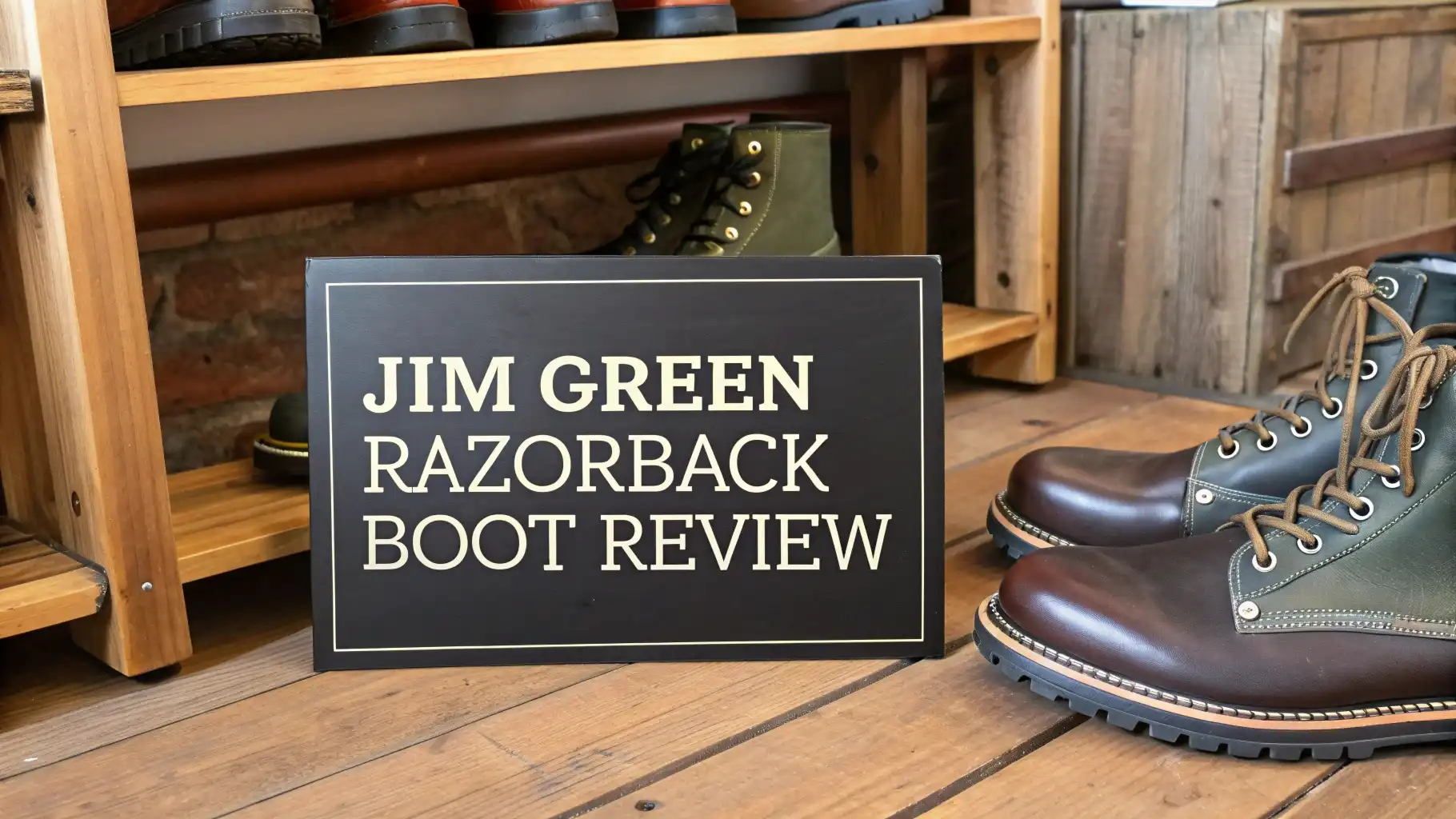
Jim Green Razorback Boot Review 2026: Still Worth It?
You want a leather boot that survives mud, gravel, and a full workday. You also want to keep money in your pocket. The Jim Green Razorback sits in that exact spot. This boot comes from South Africa, wears twin layers of real leather, and sells on Amazon for $189.99. Owners post decade long stories about theirs. Other owners post blister stories about week one. Both are true.
This review walks through the leather, the sole, the sizing, the break in, and the safety toe options. You get the good parts and the ugly parts. By the end you will know if this boot belongs on your feet or on your skip list.
In a Nutshell
- Build quality beats the price. The upper uses 2.2 mm full grain leather lined with 1.6 mm calf leather. That is two layers of hide, not one thin sheet with a plastic backing. Few boots near $190 offer this.
- The fit runs wide and true to size. Most owners order their normal sneaker size. If you plan to add a thick insole, go up half a size. The toe box is shallow, so thick socks need room.
- Break in splits owners into two camps. Some walk a trail and feel fine. Others fight heel blisters for two weeks because the heel stiffener stays stiff. Heat, patience, and thick socks help.
- Water stays out. The double stitchdown build and the gusseted tongue push water away from your ankle. Owners report stomping through puddles with dry socks.
- The stock insole is the weak link. It feels flat and thin. Budget for a better insole on day one. This single change fixes most comfort complaints.
- Safety toe versions exist. Jim Green sells a steel toe model and a composite toe model with ASTM F2413 and ISO 20345 certification. The plain soft toe stays the lightest and cheapest pick.
That list covers roughly 80 percent of what buyers ask before they order. The rest of this review fills in the details.
What the Jim Green Razorback Boots Bring to the Table

- COMFORT; Jim Green’s Razorback work boots for men are engineered with comfort and safety in mind; Our leather...
- WATER RESISTANT; More than just men’s work boots, these non slip boots for men feature a double protective...
- HI GRIP; This versatile work and hiking boot men love for the advanced traction if offers in the field; With a high...
Last update on 2026-10-20 / Affiliate links / Images from Amazon Product Advertising API
The Razorback is a six inch lace up boot. Jim Green built it for safari lodges in South Africa more than 30 years ago. Rangers walked long days in heat, dust, and thorn brush. The boot had to hold together without a cobbler nearby. That design brief still shapes the boot you buy today.
Two layers of leather form the upper. The outer layer measures 2.2 mm. The inner lining measures 1.6 mm calf leather. Together they create a stiff shell that resists cuts and scrapes. The lining also pulls moisture away from your foot better than a synthetic mesh would.
The boot uses a double stitchdown construction. Stitching runs through the upper and the midsole on both layers. This method spreads stress across many stitches instead of a few. It also lets a cobbler rebuild the boot later.
A gusseted tongue connects to the upper on both sides. Dirt and water cannot slide in through the lace gap. Jim Green also pads the tongue and the heel collar, which helps on long hikes.
Amazon lists this model at 4.5 stars from 674 ratings. That score holds steady across colors and sizes. Buyers rarely return it, which tells you something about the fit and the build.
Leather, Stitching, and Build Quality You Can Feel
Leather quality decides how a boot ages. Cheap leather cracks at the flex point within a season. The Razorback uses full grain leather, which keeps the outer grain of the hide intact. The grain holds oils and resists tearing. Scuffs buff out with a cloth and a little conditioner.
The double layer idea matters too. A single layer boot bends fast but wears through faster. Two layers add stiffness early and structure later. That trade is why the boot feels board stiff on day one and molds to your foot by week three.
Stitching density is the quiet hero here. The stitchdown rows use heavy thread and tight spacing. Owners who work in rocky ground report no seam failures after years of use. One long term owner in Arizona posted a four year update with the original sole still attached. Another posted a ten year note about a pair bought in 2012.
You will find small flaws. Some pairs arrive with a speed hook slightly out of line. Others show a small height difference between the left and right boot. These are cosmetic. They do not affect how the boot performs. Still, know that this is a workshop made boot, not a machine polished fashion product.
The Rubber Lug Sole and How It Grips
Jim Green makes its own rubber sole in South Africa. The Razorback uses the lug version with deep tread blocks. The rubber feels firm underfoot. That firmness gives you stability on gravel, ladder rungs, and packed dirt.
Soft soles feel nice in a store. They also wear fast and roll under load. This sole does the opposite. It stays flat and predictable, which matters when you carry weight or stand for eight hours.
Traction is strong on dry ground, wet grass, and loose soil. On smooth wet tile the lug pattern gives up some grip, as most deep lug soles do. Watch your step indoors after a rainy walk.
The sole is resolable. A cobbler can peel the old sole and attach a new one. That changes the math on cost. A $190 boot that takes two or three soles across fifteen years costs less per year than a $90 boot replaced every two years.
Amazon buyers mention the sole break in less than the upper break in. The rubber softens a little with flex. Most of the stiffness you feel in week one comes from the leather, not the outsole.
Top 3 Alternative for Jim Green Razorback Boots
The Razorback will not suit everyone. Maybe you need a lighter boot. Maybe you need a certified safety toe for a plant floor. These three picks cover the gaps.
1. Timberland PRO Pit Boss Steel Toe

- Timberland PRO 24/7 Comfort System: A unique comfort system that meets the most rigorous worksite demands- 24 hours...
- Steel Safety Toe: Metallic, asymmetrical-shaped toe cap that meets US safety standards including ASTM F2412-18a and...
- Electrical Hazard Protection: Provides secondary underfoot protection against live electrical circuits...

Last update on 2026-10-20 / Affiliate links / Images from Amazon Product Advertising API
This is the work site standard. It costs $109.94 and holds 4.3 stars from 27,000 ratings. The steel toe meets safety requirements. The leather upper handles scuffs and oil. It weighs more than the Razorback and breaks in faster. Pick it if your job requires a safety toe and you want to spend less.
2. Danner Bull Run 6 Inch Moc Toe

- Heritage Craftsmanship: Since 1932, Danner has crafted purpose-built moc toe boots for men, ensuring rugged...
- Lightweight Comfort: Experience cool comfort with unlined, full-grain leather that molds to your feet, perfect for...
- Cushioned Support: The removable OrthoLite footbed in these men's boots features three layers of cushioning...
Last update on 2026-10-20 / Affiliate links / Images from Amazon Product Advertising API
This boot sells for $259.95 with 4.3 stars from 2,000 ratings. It uses a wedge sole that feels soft on concrete. The moc toe shape looks clean in an office or a shop. The price sits above the Razorback, but the cushioning suits indoor floors. Pick it if you stand on hard surfaces all day.
3. KEEN Utility Lansing Steel Toe

- STEEL TOE: Left and right asymmetrical uniquely anatomically correct steel toe design provides a roomier toe box...
- TRACTION: Oil- and slip-resistant, non-marking, rubber outsoles are used for improved traction that meet or exceed...
- WATERPROOF: KEEN.DRY is a waterproof, breathable membrane liner that lets vapor out without letting water in for...
Last update on 2026-10-20 / Affiliate links / Images from Amazon Product Advertising API
This model costs $134.95 and holds 4.4 stars from 7,500 ratings. It is waterproof, lightweight, and comfortable right away. The toe box runs wide for people with broad feet. Pick it if you want a safety toe boot with almost no break in period.
Each pick trades something. The Razorback wins on leather thickness, resoling, and long term wear. The alternatives win on price, toe protection, or instant comfort.
Fit and Sizing: What Real Owners Report
Sizing causes more returns than any other issue. Get this right and you skip the pain.
Most owners order their normal sneaker size. The Razorback fits true to length. Do not size down half a size the way people do with some heritage brands. Boot reviewers who tested the boot on trails say the same thing.
Width runs generous. Jim Green builds this boot for wide feet. People with narrow feet may need a thick sock or an extra insole to fill space. People with wide feet often say this is the first boot that never pinched their toes.
The toe box is shallow. This is the one fit quirk that owners repeat. Height above your toes is limited. Very thick socks can press down on your toes. If you plan to wear heavy wool socks in winter, go up half a size.
Insole swaps change the fit. A thick aftermarket insole eats volume fast. Owners who add one usually size up half a size to keep their toes free. Some also trim the front of the insole to sit lower.
If you sit between two sizes, choose the larger one. Laces and insoles can fix a slightly loose boot. Nothing fixes a boot that pinches your toes.
The Break In Process: Honest Talk
Here is the part that separates buyers. Some owners call the break in easy. Others call it brutal.
The heel stiffener is the main complaint. It is a firm counter that holds the back of the boot in shape. New, it feels like a rock against your heel. One owner described two weeks of blisters and blister plasters before the counter softened. Another described heel pain as severe at first.
The leather softens with heat and flex. Wear the boots on warm days. Walk short distances. Let them cool on a shoe tree. Repeat. The leather molds to your ankle and heel within roughly two to three weeks of regular wear.
No break in issues for some. Reviewers who took the boot straight to a trail reported comfort within a few miles. Feet differ. Sweat differs. Your mileage will vary.
Practical tips that owners share:
- Wear them around the house for a few days before a long walk.
- Use a shoe tree to stretch the toe box height a little.
- Add a thin sock liner under the insole to lift your heel.
- Carry blister plasters on your first long day.
Plan for two weeks of short wear. That plan saves you a bad weekend.
Comfort on Long Days and How to Improve It
Once broken in, the Razorback feels supportive rather than soft. The leather hugs your arch and ankle. The firm sole keeps your foot from rolling. Owners who work long shifts say their feet feel less tired at the end of the day.
The stock insole is the weak point. It is thin and flat. It offers little arch support. Buyers who swap it for a shaped insole report a large jump in comfort. Budget about $40 for that upgrade and treat it as part of the boot price.
The padded tongue and heel collar help. So does the wide platform, which spreads pressure under your foot. The boot feels stable when you stand on uneven ground or carry a heavy bag.
Weight plays a role too. Jim Green lists the boot at about 1.56 kg for a size 8 pair. That is moderate for a leather work boot. One owner called it surprisingly light for a double lasted build. You will notice the weight on the first day and forget it by the second week.
If you need instant softness, buy a wedge sole boot. If you want a boot that supports your foot for years, this one does the job after break in.
Water Resistance and Wet Weather Performance
The Razorback handles water better than most boots in its class. Three features do the work.
The double stitchdown build closes the gap between upper and sole with two rows of stitching and a full leather layer. Water has a hard time working through that seam.
The gusseted tongue blocks the biggest entry point on any lace up boot. Owners report that water drains toward the toe instead of pooling at the tongue base.
The leather itself sheds rain once it holds conditioner. Full grain leather resists soaking when you keep it oiled. A dry boot can take a light shower without a treatment. A well oiled boot takes hours of wet grass.
Owners describe kicking through puddles and muddy trails with dry socks. That matches the design intent.
One limit: this is not a rubber boot. Standing water above the ankle will find a way in over a long day. Dry the boots slowly away from direct heat. Stuff them with newspaper overnight. Never park them next to a heater, because fast drying cracks leather.
Weight and How It Feels on Your Feet
Weight affects comfort more than most buyers expect. A heavy boot tires your legs on stairs and long walks. A light boot feels great but wears out fast.
The Razorback sits in the middle. The leather adds mass. The thin sole keeps some of it back. Owners describe it as balanced rather than heavy. Hikers who tested it on trails reported no dragging feeling.
For work use, the extra mass gives you a stable platform. For long hikes, the boot rewards a steady pace. It is not a trail runner. It is a boot that walks many miles and asks nothing in return.
If weight is your top concern, look at a synthetic safety toe boot instead. If durability matters more, accept the mass and enjoy the support.
Razorback Safety Toe Options for Job Sites
Jim Green sells three toe setups. Choose by your job requirements, not by looks.
Soft toe plain. This is the classic Razorback. Cheapest and lightest. Good for hiking, farm work, and casual wear.
Steel toe. Jim Green lists this model around $209.99. It carries ASTM F2413 certification and ISO 20345 approval. The steel cap protects your toes from dropped loads. It also adds weight and reduces toe room slightly.
Composite toe. This model runs about $224.99 to $229.99 depending on color. The composite cap meets the same standards without metal. It feels warmer in cold weather and passes through metal detectors. Many workers prefer it for those reasons.
Both safety versions keep the same leather and sole build. You lose nothing in durability. You do lose a little toe height, so try them on before a long shift.
Check your workplace rules first. Some sites require a specific standard label. Buy the version that matches the requirement, then enjoy the leather.
Pros and Cons of the Jim Green Razorback
Pros
- Thick leather build with two full layers at a fair price
- Resolable construction that stretches the cost across many years
- Strong water resistance from the stitchdown build and gusseted tongue
- Wide fit that suits broad feet
- Solid traction from the deep rubber lug sole
- Safety toe versions available with real certification
- Simple design that cleans up and looks better with age
Cons
- Firm heel counter causes blisters for some owners during break in
- Shallow toe box limits thick socks
- Stock insole offers little support and needs replacing
- Noticeable weight compared with synthetic boots
- Occasional small finish flaws out of the box
- No half sizes in every color and width combination
Read that list and judge honestly. If the cons describe things you can live with, the pros will serve you for a decade.
Price and Value in 2026
- COMFORT; Jim Green’s Razorback work boots for men are engineered with comfort and safety in mind; Our leather...
- WATER RESISTANT; More than just men’s work boots, these non slip boots for men feature a double protective...
- HI GRIP; This versatile work and hiking boot men love for the advanced traction if offers in the field; With a high...
Last update on 2026-10-20 / Affiliate links / Images from Amazon Product Advertising API
The Razorback lists at $189.99 on Amazon for the brown soft toe model. Other colors and the safety toe versions land between $200 and $230. That places it above budget work boots and below premium American made brands.
Now do the long math. A boot that lasts ten years and takes one resole costs about $25 per year. A cheap boot that dies in two years costs more, and it costs you a shopping trip each time. The Razorback wins this comparison clearly.
Resale value holds up too. Used pairs in decent shape still sell, which is rare for work boots.
Watch for price swings on Amazon. Sizes and colors move by $10 or more through the year. The safety toe models rarely drop much because supply is limited.
One honest caution: this boot is not the cheapest way to put leather on your feet. It is the cheapest way to put two layers of leather and a rebuildable sole on your feet. That is the value claim, and it holds.
Care and Maintenance Tips
Good care doubles the life of any leather boot. The routine for the Razorback is simple.
Brush off dirt after each wear. Grit works into the leather grain and cuts fibers over time. A stiff brush takes ten seconds.
Condition the leather every two to three months. Use a leather cream or oil. Warm the boot slightly first so the product soaks in. Wipe off the excess.
Keep the stitching dry. Water sitting in the stitch rows weakens thread. Dry boots slowly at room temperature with newspaper inside.
Rotate two pairs if you can. A boot that dries fully between wears lasts far longer than one worn daily.
Replace the insole before it flattens. A dead insole transfers shock to your joints, not just your feet.
Check the sole edge each season. Small cracks grow fast. A cheap repair now beats a full rebuild later.
Store boots on a shoe tree. It holds the shape and pulls moisture out of the lining. Skip plastic bags, which trap damp air.
Who Should Buy the Razorback and Who Should Skip It
Buy it if you want one boot for hiking, farm work, and everyday wear. Buy it if you have wide feet. Buy it if you like leather that ages well and a boot you can rebuild instead of replace. Buy it if you accept a short break in period as part of the deal.
Skip it if you need a soft, cushioned boot from day one. Skip it if you stand on concrete for ten hours and want a wedge sole. Skip it if you have very narrow feet and dislike thick socks. Skip it if the tallest toe box matters because you wear heavy winter socks daily.
Think about your week. Count the surfaces you walk on. Count the hours you stand. If most of that time happens outdoors on dirt, gravel, or grass, the Razorback fits your life. If most of it happens indoors on tile, a cushioned work boot serves you better.
This is a tool, not a fashion statement. Buy it for the job you actually do.
Jim Green Razorback vs Popular Work Boots
Owners often compare this boot with a few well known names. Here is how the matchups look.
Against the Timberland PRO Pit Boss. The Pit Boss costs less and breaks in faster. The Razorback uses thicker leather and can be resoled. Pick the Pit Boss for budget and quick comfort on a job site. Pick the Razorback for long term wear and outdoor use.
Against the Danner Bull Run. The Bull Run costs more and offers a softer wedge sole. It suits concrete floors and shop work. The Razorback wins on traction and leather thickness. Pick the Danner for indoor standing. Pick the Razorback for mixed terrain.
Against the KEEN Utility Lansing. The Lansing feels light and comfortable out of the box. It also uses more synthetic material. The Razorback feels heavier, lasts longer, and repairs better. Pick the KEEN for immediate comfort with a safety toe. Pick the Razorback for leather that molds to your foot.
Against the Jim Green African Ranger. Same maker, different shape. The African Ranger runs lighter and more flexible. The Razorback carries more leather and a heavier lug sole. Hikers often choose the Ranger. Workers and heavy trail users often choose the Razorback.
No boot wins every category. Match the boot to your ground, your hours, and your budget.
Final Verdict: Is the Jim Green Razorback Worth It in 2026?
The Jim Green Razorback earns a clear recommendation for the right buyer. It delivers two layers of real leather, a rebuildable sole, and strong water resistance for about $189.99. That mix is hard to find at this price in 2026.
The boot asks for patience. The heel counter and the stiff leather will test you for a couple of weeks. The stock insole needs replacing. The toe box wants thin socks. Accept those terms and you get a boot that molds to your foot and works for a decade.
Owners keep proving the point. One pair logged four years of hard field work in Arizona. Another pair ran ten years. People who wear this boot for a living keep buying it again.
Buy the Razorback if you work outdoors, walk rough ground, and want leather that earns its keep. Skip it if you need instant cushion or a soft indoor boot. For everyone in the first group, this is one of the smartest boot purchases you can make this year.
Frequently Asked Questions
Do the Jim Green Razorback boots run true to size?
Yes for most people. Order your normal sneaker size. If you plan to add a thick insole or wear heavy socks, go up half a size because the toe box sits low.
How long does the break in take?
Plan for two to three weeks of short wear. Some owners report comfort after one hike. Others fight heel blisters for two weeks. Heat, movement, and a few short walks speed the process.
Are the Razorback boots waterproof?
They resist water well but they are not sealed waterproof boots. The double stitchdown build and the gusseted tongue keep rain and puddles out. Deep standing water above the ankle will eventually soak in.
Can the soles be replaced?
Yes. A cobbler can attach a new sole when the tread wears down. That is a main reason owners keep these boots for ten years or more.
Is there a steel toe version?
Yes. Jim Green sells a steel toe model and a composite toe model. Both carry ASTM F2413 and ISO 20345 certification. They cost about $20 to $40 more than the soft toe.
Are they good for wide feet?
Yes. The last runs wide across the forefoot. Owners with broad feet praise the room. Owners with narrow feet may need thicker socks to fill the volume.
What is the weight?
Jim Green lists about 1.56 kg for a size 8 pair. That is moderate for a leather boot with a rubber lug sole. It feels stable rather than heavy once broken in.
Do I need a different insole?
Most owners say yes. The stock insole is thin and flat. A shaped aftermarket insole improves arch support and reduces foot fatigue on long days.

Dan is a passionate fashion enthusiast and experienced product reviewer who combines years of industry knowledge with a keen eye for quality and style. Through Fashion Reviewer Blog, he provides honest, detailed reviews and practical guides to help readers make informed fashion decisions and discover their personal style.